Blog
When Students Finish Early: A List That Beats Boredom
The class is finally working. It's quiet, and you're crouched next to a desk explaining a task for the third time when a student sets down her pencil and looks around the room. You know exactly what that means: the waiting has begun.
A moment later comes the question you've probably heard a dozen times already today: “I'm done. What should I do now?” And while you're still thinking, the next table has drifted off too.
You want to be fair to everyone, to the students who still need help and to the ones who are already ahead. But you've only got two hands and a head that's busy with something else entirely. What helped me most was not having to answer that question from scratch every single time, and a visible list can take that job off your hands.
Why a list for when students finish early makes such a difference
Neurodivergent describes differences in how people perceive, think, learn and process the world around them, and those differences look different in every student. Some students lose their footing as soon as a task is finished. The work is done, but what comes next is wide open, and that openness is exactly what's hard for them.
A visible list makes the next step predictable, which can cut down on downtime, questions and needless interruptions, for the student and for you. It fits what's recommended for supporting students with ADHD at school, too: help with organization, meaning planning time and keeping materials in order. Visual supports, clear keywords and small steps also make learning easier for many students.
To be honest, the list isn't the answer for every student. You'll want to look together at which tasks fit and make sense. But it's a good start, and once it's in place it takes very little work.
A tip you can try tomorrow: build your list in six steps
-
1. Introduce the list before the first use
Show the class what happens after a task is finished, then practice the routine once without any time pressure. Something like: “First check your work. Then pick one thing from the list.”
-
2. Keep the choices few
Start with five to seven options, and give each one a visible result. Reading, drawing, sorting, practicing or quiet planning all work well. Skip “Find something to do.” That leaves far too many questions open.
-
3. Separate the must-do from the free choice
Start with a short check routine: check the assignment, write your name, put materials away. Only then does the student pick an activity, so the list never becomes a shortcut around careful work.
-
4. Offer activities at different levels
Some students need quiet after working, while others want to keep thinking or get moving. So offer quiet reading, a puzzle, and a short tidying job. Drawing something about the current science or social studies topic is a nice option too.
-
5. Make the start and the finish visible
For each activity, write down the first step and the end point, for example: “Read two pages. Then put the book back in the bin.” That makes it easier for students to get going on their own, and to stop again.
-
6. Check in on the list briefly
After a few days, ask: “Which one was easy to get started on?” And: “Which task was too easy, too hard, or too unclear?” Then change just one item, so you can see more clearly what really works in your day.
If things still get stuck: small stumbling blocks
The list should feel inviting, never like a punishment, so phrase the activities neutrally and in a way that sparks curiosity. Not everyone has to do the same thing, either. Different approaches and levels are more than welcome.
If the list gets too long, cross out the items nobody picks. If a student suddenly starts rushing through work to get to the list faster, the short check routine at the start helps. If a task drags on and never really ends, give it a clear start and a clear finish. And if an activity distracts others, mark which tasks are the quiet ones and agree on where students can work.
One last thought that has often helped me: don't expect any particular result. Just watch whether the next step gets easier. If you hear “What should I do now?” a little less often, that's already a lovely win.

Download: “When I'm Done”
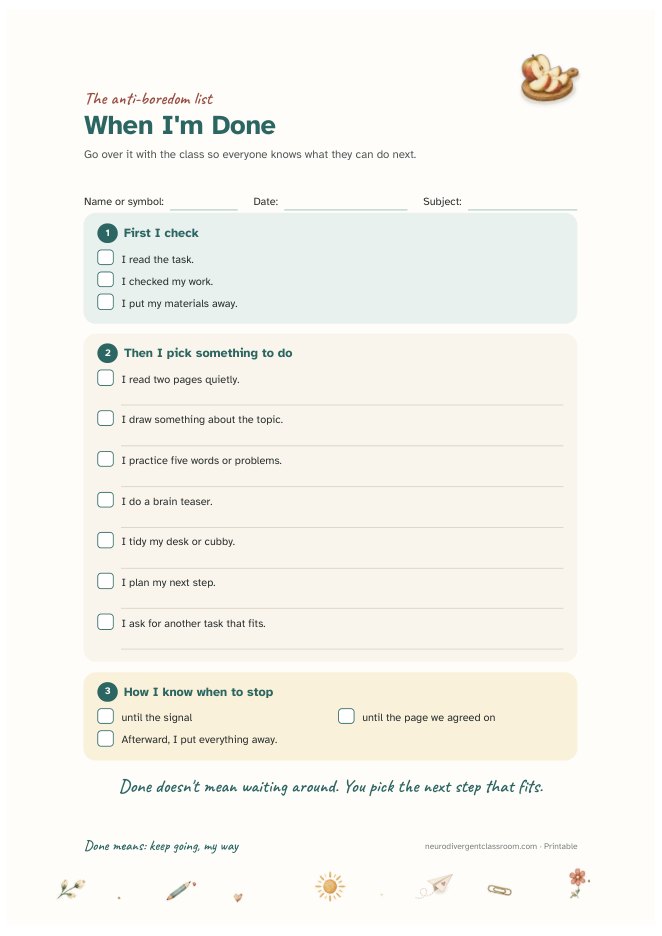
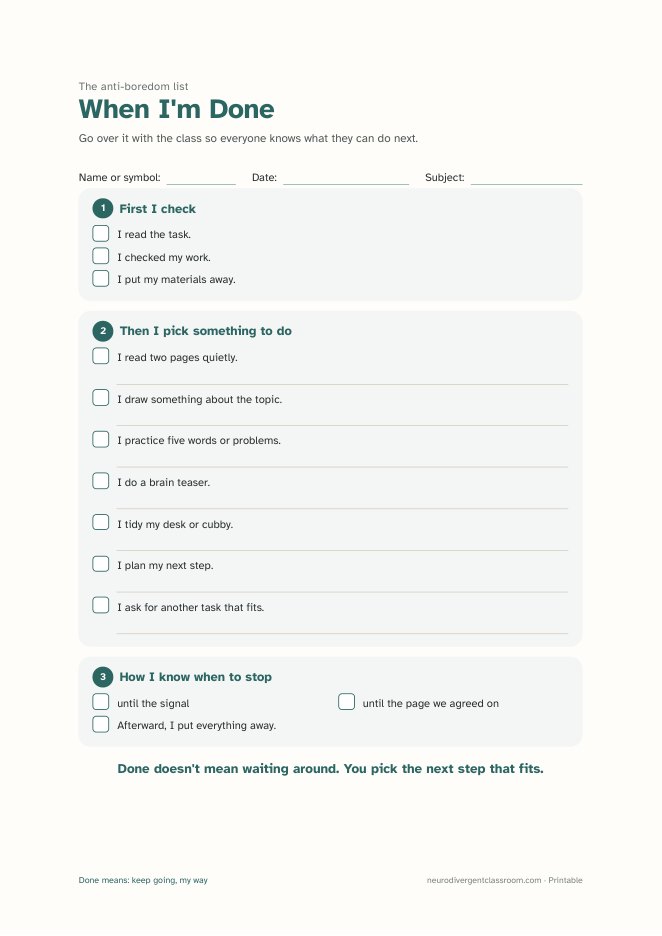
This sheet answers “What should I do now?” before anyone has to ask. At the top, students fill in their name or symbol, the date and the subject, followed by “First I check” with three boxes to tick. Under “Then I pick something to do” there are seven options, from quiet reading to a puzzle to asking for another suitable assignment, each with a blank line for your own ideas. “How I know when to stop” makes the finish clear, and at the very bottom is an encouraging line: “Done doesn't mean waiting around. You pick the next step that fits.” Walk through the sheet with the class once, and many students will soon find their way around it on their own.
Every printable comes in a colorful and a simple version. Choose the one you like to work with. Click the image to open the printable.
And one just for you
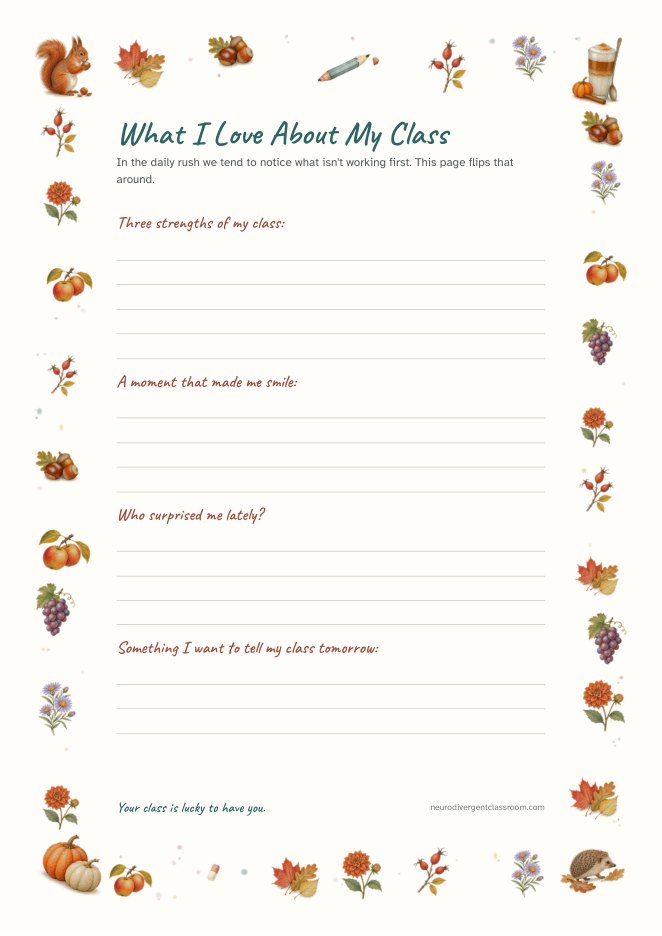
A page to take a breath and write things down, no lesson planning involved.
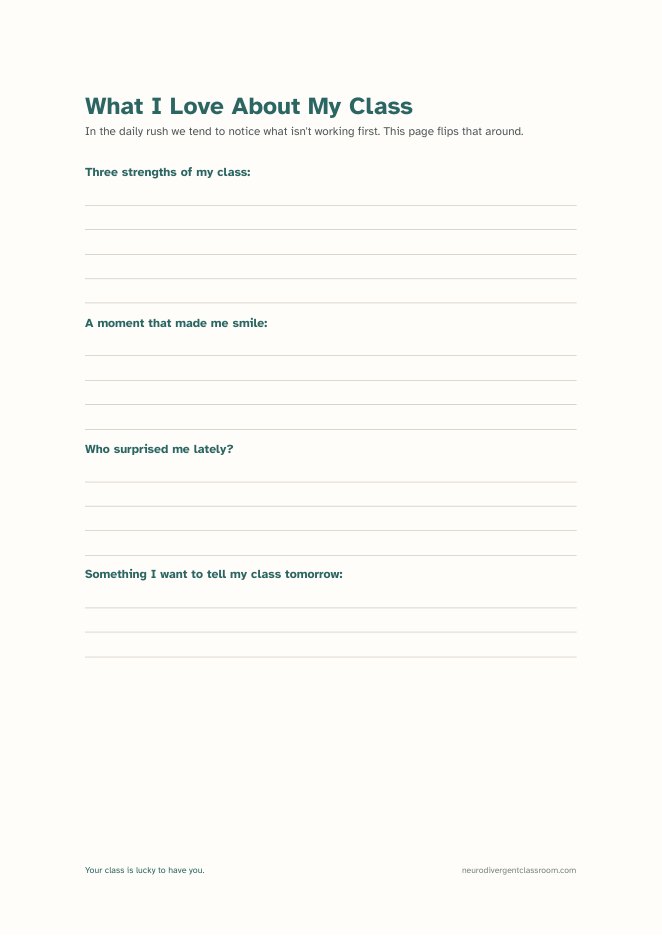
You will find these and all other printables collected in the Teacher Portal (members only).
You don't have to be everywhere at once. When your students know what comes after finishing, you win back a few calm minutes for the ones who need you most right now.
Related topic pages in the Teacher Portal
The topic pages explain why this kind of support might work for your students.
The page on ADHD has notes on organization, assignments and transitions.
The page on autism adds perspectives on predictability, routines and different ways of communicating.
For sensory overload, see the page on sensory sensitivity.
For auditory processing, you'll find notes on auditory processing disorder (APD), and for math tasks, the page on dyscalculia is a good fit.
Sources
- Centers for Disease Control and Prevention: ADHD in the Classroom, accessed October 14, 2026.
- Department for Education: Theory: working with the SENCO, accessed October 14, 2026.