Blog
Weekly Plans for School and Home: A Week Students Can See
It's Monday morning, class is getting started, and somehow a dozen tasks seem to crowd into the room at once. There's been a change in who's covering which class, a deadline is creeping closer, and a worksheet has gone missing somewhere. For what feels like the hundredth time, a student asks: “What are we doing today? And what about tomorrow?”

I know these Monday starts well. The weekend is still in your bones, your head is busy sorting appointments, grading and meetings, and at the same time you want everyone to know where they stand. Giving the same explanation five times drains energy you badly need for other things.
That's where a weekly plan can take a lot off your plate. It makes the week's tasks, their order and the free time in between visible, so you can give students their bearings without walking them through every step out loud. And it keeps working beyond the classroom door, all the way to the desk at home.
Why a weekly plan can be such a relief
Neurodivergent describes differences in how people perceive, think, learn and process the world around them, and those differences look different in every student. For many of them, holding tasks, dates and transitions in their heads is exhausting, and a plan on paper takes that weight off.
A weekly plan can smooth out transitions and make assignments feel manageable. One thing matters to me here, though: it isn't proof of any particular trait and it doesn't replace a professional assessment. It's simply a good tool that helps a lot of students.
For students with ADHD, it can help to back up spoken instructions with written ones, and shorter work periods with planned movement breaks are recommended too. A weekly plan brings both together quite naturally.
There's an idea from lesson planning that fits here as well: Universal Design for Learning, or UDL. You plan different paths to learning right from the start, including clear goals, help with planning and visible progress, which is exactly what a good weekly plan can offer.
A tip you can try this week: seven steps to a weekly plan that really helps
-
1. Show the whole week on one page
Make the days of the week your columns and fill in classes, breaks, appointments and due dates. Mark fixed times the same way every time, so students can see at a glance what's already set.
-
2. Keep each day manageable
Plan a few core tasks and label extra tasks clearly, because too many boxes turn the plan itself into a hurdle. Phrase every assignment with a visible result, such as “Do problems 3 to 5.”
-
3. Break big tasks into steps
For a presentation, “Choose a topic” comes first, then “Gather information,” “Write an outline,” and “Present.” That way the next step is always visible, and the student doesn't have to keep the whole project in mind at once.
-
4. Plan the start, the break and the finish
For longer tasks, add three boxes: “I start at,” “I take a break at,” and “I stop at.” A break is a planned part of the work, not a reward and not a punishment.
-
5. Show it in more than one way
Write short words and add symbols where they help. Students can read the plan, check things off, or color them in. Some prefer a list, while others need a timeline or separate cards.
-
6. Send home only what's needed
Mark homework with the same symbol every time and note the materials and the due date. The weekly plan stays in the backpack or is available online, so nobody has to piece information together from several notebooks, not even the parents at night.
-
7. Look at the plan together
On Monday, ask: “What's already clear about this week? Where do you need a smaller step?” And on Friday: “What helped you get started?” Then change just one thing, so you can see what difference it makes.

Keeping the plan helpful
I've often seen plans made with the best intentions fill up more and more until nobody wants to read them. So include only what helps students decide or act. If an assignment is still unclear, add a verb and a visible result: “Math” doesn't say much, while “Do problems 3 to 5” says exactly what to do.
The tone matters a lot to me. A weekly plan is there to guide, not to keep tabs on anyone, and once it turns into monitoring it quickly loses its value for the student.
Sudden changes are especially hard for many students, so make a substitute teacher, a room change or a rescheduled date easy to spot. And don't forget the finish line: a handed-in assignment, a check mark or a clear ending shows that something is really done.
One format rarely suits everyone, so if it's practical, offer a list, a table or cards. And rather than promising results, check together with your class whether the plan actually makes daily life easier.

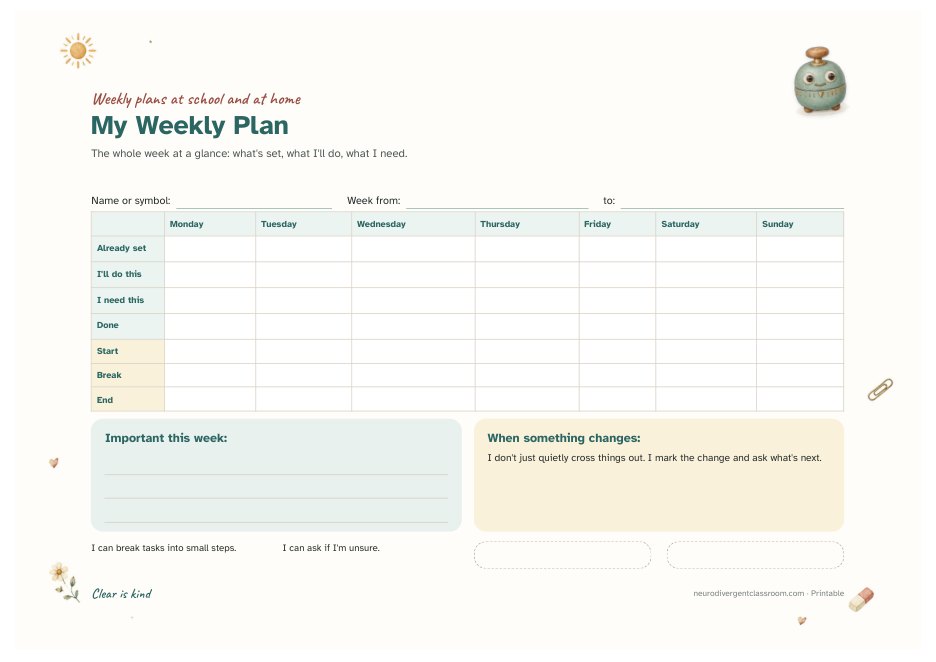
Download: “Fill-In Weekly Plan”
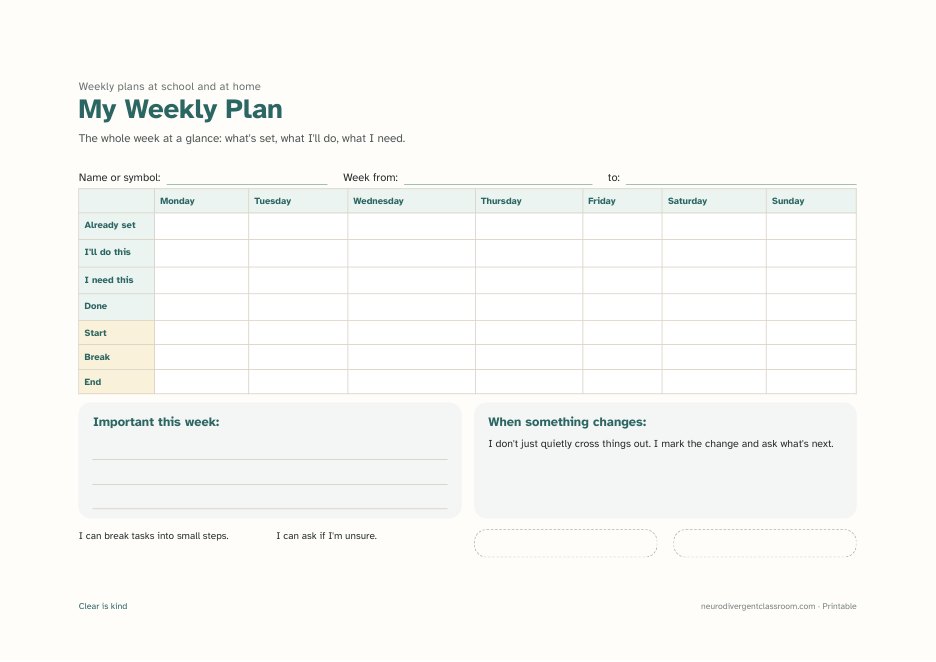
This plan shows the whole week from Monday to Sunday at a glance, for school and for home. Under each day are four lines: “Already set,” “I'll do this,” “I need this,” and “Done.” In the margin there's start, break and finish, with space for the time, a break idea and a turned-in mark. “Important this week” has room for appointments, room changes or materials, and “When something changes” offers a calm sentence for dealing with surprises. At the very bottom are two encouraging sentences and two empty boxes for your own, and the back has four small cards for task, materials, break and done. It works best to choose the format together with the student and walk them through the page briefly.
Every printable comes in a colorful and a simple version. Choose the one you like to work with. Click the image to open the printable.
And one just for you
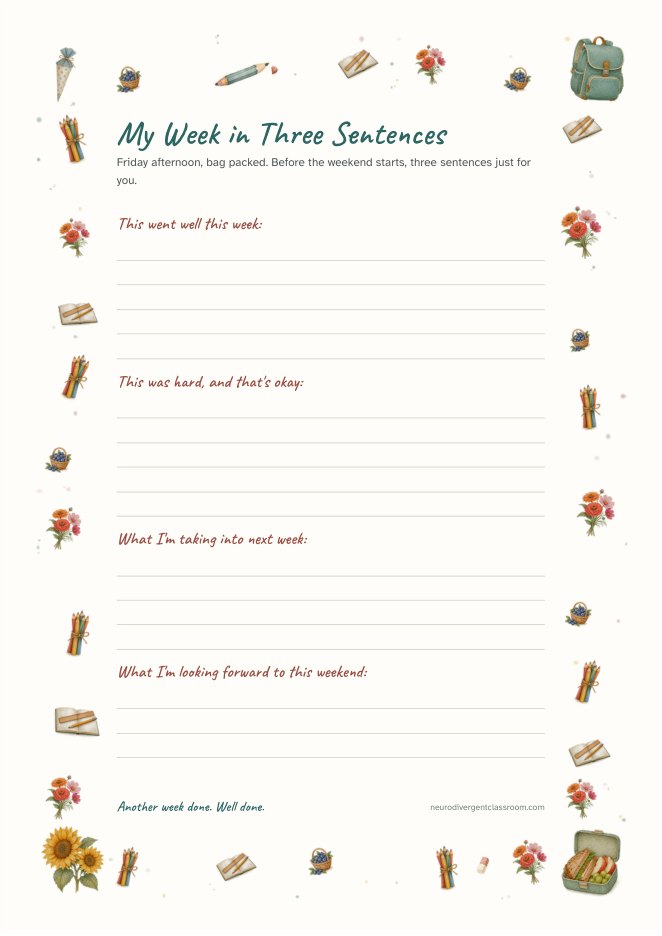
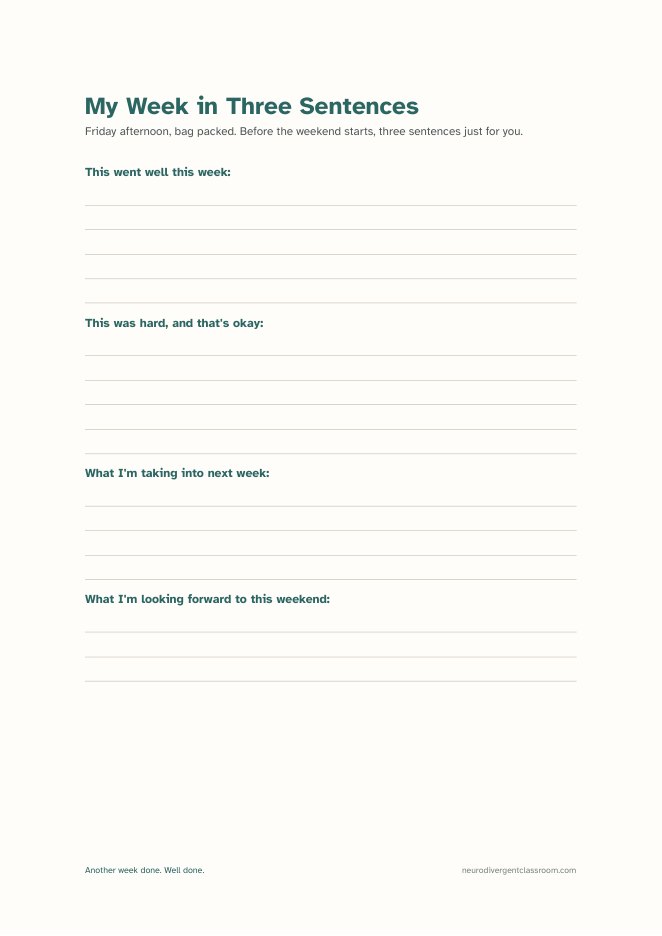
A page to take a breath and write things down, no lesson planning involved.
You will find these and all other printables collected in the Teacher Portal (members only).
You don't have to answer every question yourself on Monday morning. A good plan on the wall or in the notebook does that for you, and you get back a little calm for the things only you can give.
Related topic pages in the Teacher Portal
The page on ADHD has notes on structure, work periods and written instructions.
The page on autism adds perspectives on transitions, predictability and different ways of communicating.
For sensory overload, see the page on sensory sensitivity, and for auditory processing, the notes on auditory processing disorder (APD).
The pages on dyscalculia and dyspraxia and DCD can also be useful when you plan tasks.
Sources
- NICE: Attention deficit hyperactivity disorder, Recommendations, recommendations on environmental adjustments, written instructions, and movement breaks, accessed October 14, 2026.
- CAST: Universal Design for Learning Guidelines 3.0, notes on goal setting, planning, resources, and monitoring progress, published July 30, 2024, accessed October 14, 2026.