Blog
Introverted Students: Class Participation Without the Pressure
The class discussion is in full swing, and one student keeps her eyes on her notebook and never raises her hand. Later, during partner talk, you happen to overhear her walking a classmate through the solution, step by careful step. And you catch yourself thinking: I wish the whole class had heard that.
Maybe the other side of this is familiar too. Grades for class participation are coming up, and you're wondering how you're supposed to assess something you can barely hear. You want to be fair to everyone, in a full room, with too little time and plenty of louder voices competing for it.
I know that bind well. What helped me was flipping the question around. Instead of asking how to get this student to speak, I started asking how to make visible what she or he is already thinking.

Quiet doesn't mean checked out
Introversion is a personality tendency, not a diagnosis and not a fixed ability. Introverted students can love learning alongside others. They may just need more quiet, more time, or a smaller, more manageable setting for conversation.
It's also a trait that's easy to overlook in school. What protects and strengthens introverted teenagers is supportive relationships and the sense that they're accepted as they are, and social engagement is linked to their well-being too. So the goal isn't to make students louder. It's real participation, in ways that suit them.
Neurodivergent students benefit from this as well. Some need more predictability because of sensory processing, language, or anxiety, and clear routines plus different ways to respond lower the barriers for the whole class.

A tip you can try tomorrow: eight ways to open up participation
-
1. Give thinking time before answers
Ask the question, then announce ten seconds of thinking time and have everyone write first. After that, students can say or show their answer if they want to. A line like “Jot down one thought. You'll share it with a partner in a minute” takes a lot of pressure off. Mary Budd Rowe's classic research on wait time found that teachers often wait one second or less for an answer. When they wait at least three seconds, students give longer answers and more of them join in.
-
2. Build participation up in stages
Start with individual work, move to talking in pairs, and only then open things up to the whole group. That gives students a path from thinking in a safe space to learning together.
-
3. Make the ways to respond visible
Offer speaking, writing, drawing, pointing, or typing an answer. The learning goal stays the same. Only the way there gets easier.
-
4. Say ahead of time when talking will happen
Write down when you'll be asking for contributions, and skip the surprise cold calls. For example: “In five minutes we'll go over question two. You can read your sentence aloud or hand it in.”
-
5. Give group work a structure
Hand out clear roles and a short task, and let everyone gather ideas on their own first. One student might then take notes or sort the results.
-
6. Start calmly
After recess, begin with a quiet task and post the first three steps where everyone can see them. That supports every student who finds transitions or a lot of stimulation draining.
-
7. Don't measure knowledge by volume
Collect evidence of learning through notes, finished work, conversations, and your own observations. A spontaneous comment only ever shows part of what a student has learned.
-
8. Check in privately
Ask the student one-on-one: “How could you take part in a way that feels okay today?” Then agree on one small, concrete option and look back together later at whether it's working.

What you can spare yourself and your student
Some well-meant habits land especially hard on quiet students. Holding back isn't a sign of missing knowledge, eye contact isn't proof of attention, and a student who doesn't say much isn't automatically insecure around others.
So don't ask a quiet student to explain their quietness in front of the class. Introversion isn't a problem that needs to go away. And it's best not to read anything diagnostic into single observations. That isn't your job at all, which can actually be a relief.
I've seen again and again how much it means when a quiet student realizes their thinking gets noticed here, even when they don't say it out loud. That doesn't take a big program, just a few paths they can count on.
When silence is more than reserve
Introversion and selective mutism aren't the same thing. With selective mutism, anxiety can make speaking impossible in certain situations: the student may want to talk but can't in that moment. The NHS describes selective mutism as an anxiety disorder that usually begins in childhood, and stresses that the person isn't refusing or choosing not to speak.
If a student can't speak in certain situations over a longer stretch of time, professional support is needed. You don't have to make that call alone. Talk with your colleagues and with the specialists who support your school.
Related topic pages in the Teacher Portal
For a closer look at selective mutism, including ideas for participation without pressure to speak, start there.
When sensory overload is part of the picture, the page on sensory sensitivity can help, and for differences in communication and processing, see autism. The ADHD page also shows how clear structures make participation easier.

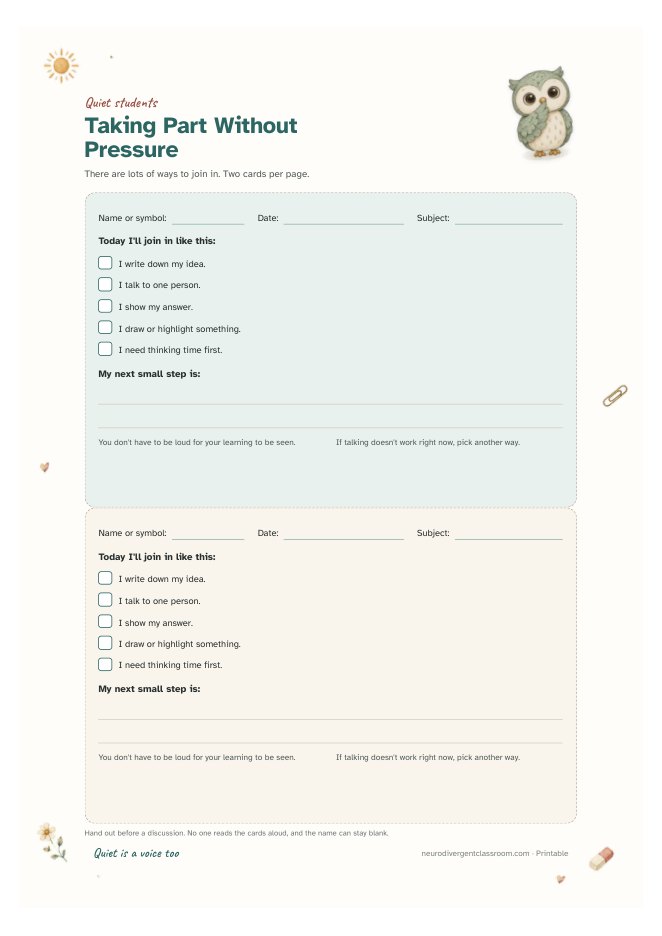
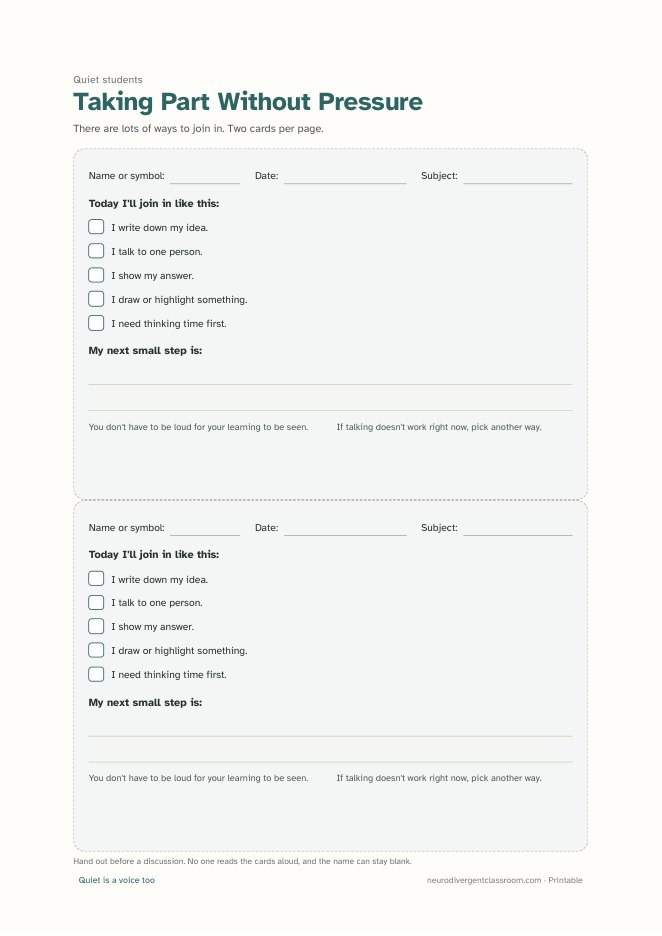
Download: “Participation Without Pressure” Card
With this card, each student picks what taking part can look like for them today: writing it down, talking with one person, showing the answer, drawing or marking something, or thinking quietly first. Underneath there's room for the next small step. The name line can stay blank, so the card works completely anonymously too. Hand it out before a discussion, and never read it aloud to the class. At the bottom is a sentence that many quiet students need to hear: “You don't have to be loud for your learning to be seen.”
Every printable comes in a colorful and a simple version. Choose the one you like to work with. Click the image to open the printable.
And one just for you
A page to take a breath and write things down, no lesson planning involved.
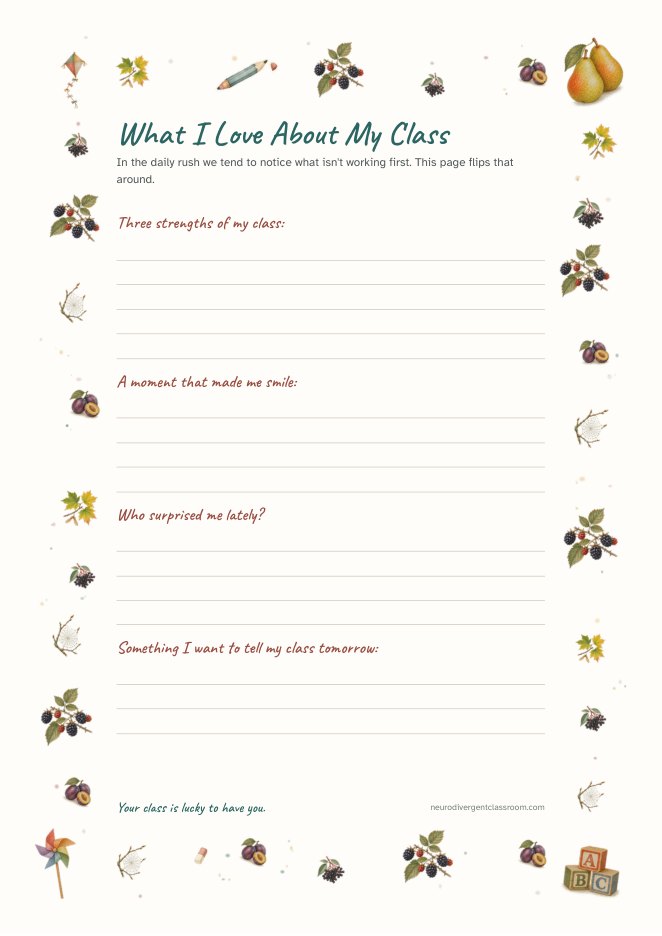
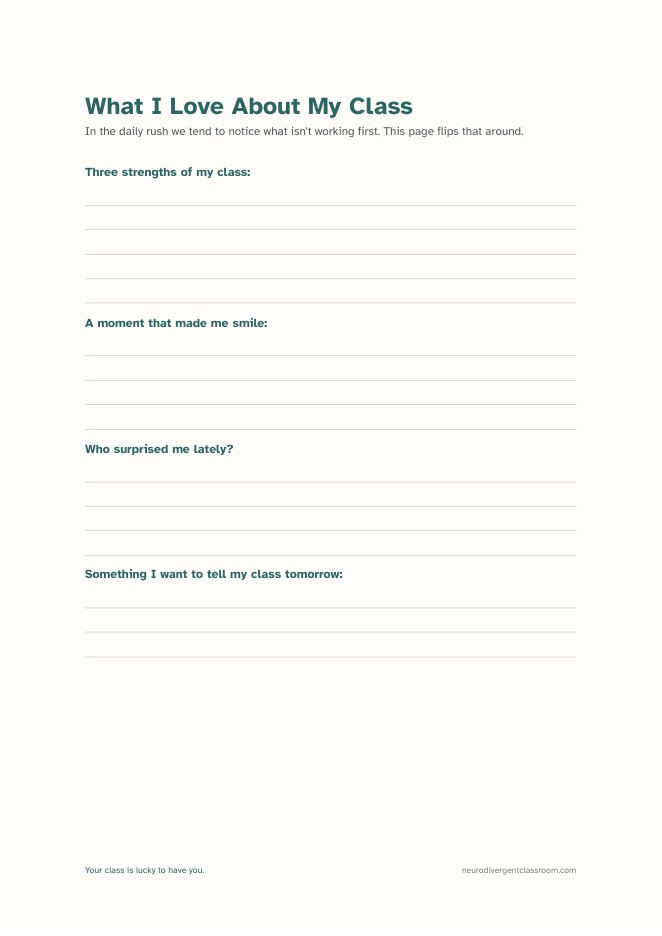
You will find these and all other printables collected in the Teacher Portal (members only).
You don't have to make anyone louder. Open up a second path, and you'll often hear thoughts that were there all along.
Sources
- Tuovinen et al.: Introversion and Social Engagement, 2020, accessed October 14, 2026.
- Murphy et al.: Is personality overlooked in educational psychology?, 2024, accessed October 14, 2026.
- AWMF: S1 guideline on elective mutism (in German), as of 2006, validity expired, accessed October 14, 2026.
- NICE: Autism spectrum disorder in under 19s, Recommendations, accessed October 14, 2026.
- NHS: Selective mutism, accessed November 14, 2026.
- Rowe, M. B.: Wait Time: Slowing Down May Be a Way of Speeding Up!, Journal of Teacher Education, 37(1), 1986, pp. 43 to 50, accessed November 14, 2026.